

What Is A Spread In Forex
What is spread in Forex Trading?
Spread is ane of the most commonly used terms in the world of Forex Trading. The definition of the concept is quite simple. We have two prices in a currency pair. Ane of them is Bid price and the other is Ask price. Spread is the divergence between the Bid (selling toll) and the Inquire (buying cost).
With the business point of view, brokers have to make coin against their services.
- The brokers make coin past selling a currency to the traders for more what they pay to buy it.
- The brokers as well make money past ownership a currency from the traders for less than what they pay to sell it.
- This deviation is chosen spread.
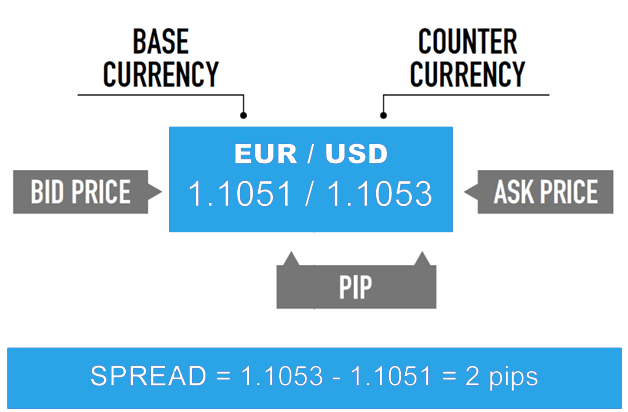
What does spread mean?
The spread is measured in terms of pips which is a pocket-sized unit of price movement of a currency pair. It is equal to 0.0001 (quaternary decimal point on quote price). This is truthful for virtually of the major pairs while Japanese Yen pairs accept second decimal point as the pip (0.01).
When the spread is broad, it means the departure between "Bid" and "Ask" is high. Hence, the volatility will exist high and liquidity will exist depression. On the other hand, lower spread means low volatility and loftier liquidity. Thus, the spread cost volition be small when the trader trades a currency pair with tight spread.
By and large currency pairs accept no committee in trading. So spread is the only cost that traders accept to bear. Nearly of the forex brokers do not charge commission; hence, they earn past increasing the spread. The size of spread depends on many factors like market volatility, broker type, currency pair, etc.
What does the spread depend on?
The spread indicator is usually presented in the class of curve on a graph that shows the direction the spread betwixt the "Ask" and "Bid" prices. This tin assistance the traders to visualize the spread of a currency pair over the time. The most liquid pairs have tight spreads while exotic pairs have wide spreads.
In the simple words, the spread depends on market place liquidity of a given financial instrument i.east., the higher the turnover of a particular currency pair, the smaller the spread. For case, EUR/USD pair is the most traded pair; therefore, the spread in the EUR/USD pair is the lowest amidst all other pairs. Then there are other major pairs like USD/JPY, GBP/USD, AUD/USD, NZD/USD, USD/CAD, etc. In the case of exotic pairs, the spread is multiple times larger as compared to the major pairs and that'south all because of thin liquidity in exotic pairs.
Any short-term disruption to liquidity is reflected in the spread. This refers to situations like macroeconomic information releases, the hours when major exchanges in the world are closed, or during major banking concern holidays. The liquidity of instrument allows to decide whether the spread will be relatively large or small.
- Economic news
Market volatility may affect the spreads in forex. For example, the currency pairs may experience wild price movements at release of major economical news. Thus, the spreads are also affected at that time.
If you want to avoid a situation when spreads go too broad, and then yous should keep an eye on the forex news calendar. It will help you to stay informed and tackle the spreads. Like, non-farm payrolls data of the U.South. brings a high volatility in the marketplace. Therefore, the traders can stay neutral at that fourth dimension to mitigate the risk. However, unexpected news or data are hard to manage.
- Trading volume
Currencies with loftier trading volume have usually low spreads such as the USD pairs. These pairs accept high liquidity merely still these pairs have risk of widening spreads amongst economic news.
- Trading sessions
Spreads are likely to remain low during the major market sessions like Sydney, New York and London sessions, particularly when the London and New York sessions overlap or when the London session ends. Spreads are as well affected by general demand and supply of currencies. Loftier demand of a currency will result in narrow spreads.
- Importance of broker's model
Spread is also dependent on business concern model of a broker.
- Marketplace makers mostly provide fixed spreads.
- In the STP model, it can be a variable or stock-still spread.
- In ECN model, we only have market spread.
All of these broker models have their own pros and cons.
What types of spreads are in Forex?
The spread tin can be fixed or variable. Similar, indices take fixed spreads mostly. The spread for Forex pairs are variable. So, when the bid and ask prices change, the spread also changes.
i. Fixed spread
The spreads are fix by the brokers and they do not change regardless of market conditions. The run a risk of a liquidity disruption is on banker's side. Withal, the brokers proceed high spread in this blazon.
Market maker or dealing desk brokers offering stock-still spreads. Such brokers buy large positions from liquidity providers so offer those positions in small portions to the retail traders. The brokers actually deed as a counterparty to the trades of their clients. With the help of a dealing desk, the forex brokers are able to fix their spreads every bit they are able to control the prices that are displayed to their clients.
As the price comes from a unmarried source, thus, the traders may oft face up trouble of requotes. There are sure times when the prices of currency pairs change speedily amid loftier volatility. Since the spreads remain unchanged, the broker volition not be able to widen the spreads in order to adjust to the current market conditions. Therefore, if y'all attempt to buy or sell at specific cost, the broker will not allow to place the order rather the broker will inquire y'all to take the requoted cost.
The message of requote will be displayed on your trading screen to inform you that the toll has moved and if you lot agree to accept the new price or not. It is more often than not a cost that is worse than your ordered cost.
When prices move too fast, you lot may confront the consequence of slippage. The broker may not exist able to maintain the fixed spreads and your entry price may be different than your intended price.
2. Variable Spread
In this blazon, spread comes from the market and the broker charges for its services on top of it. In this case, the broker has no risk because of liquidity disruption. The traders usually enjoy tight spreads except for volatile market movements.
Non-dealing desk brokers offering variable spreads. Such brokers get their cost quotes of currency pairs from many liquidity providers and theses brokers pass the prices straight to the traders without any intervention of a dealing desk. It means that they have no control over the spreads and spreads volition increase or decrease depending on overall volatility of the market and supply and demand of currencies.
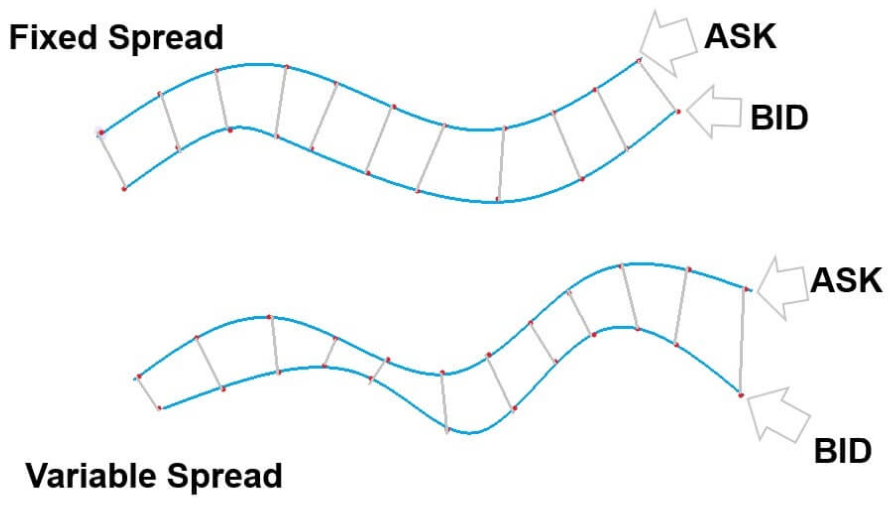
Comparison of stock-still and variable spreads
Some of the advantages and disadvantages of fixed and variable spreads are discussed as below:
Some of the benefits and drawbacks of these ii types of spreads are outlined below:
| Stock-still Spread | Variable Spread |
| May have requotes | Chance of requotes does not exist |
| Transaction cost is predictable | Transaction toll is not always anticipated |
| Uppercase requirement is pocket-size | Capital requirement is relatively bigger. |
| Advisable for beginners | Appropriate for avant-garde traders |
| Volatile marketplace does non affect the spread | Spread may get widened at times of high volatility |
How are spreads measured in Forex trading?
The spread is calculated within the toll quote past terminal large number of enquire and bid price. The last large numbers are 9 and four in the epitome below:
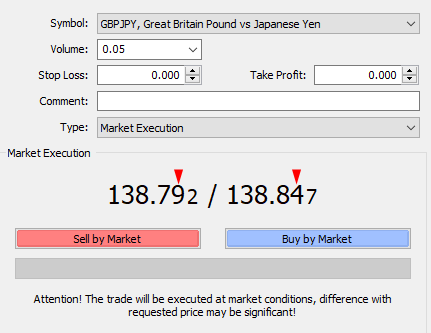
You have to pay the spread upfront whether yous trade through CFD or spread betting account. This is the aforementioned as traders pay committee while trading shares CFDs. The traders are charged for both entry and leave of a trade. Tighter spreads are highly favorable for traders.
For example: The bid cost for the GBP/JPY pair is 138.792 while the enquire price is 138.847. If you subtract 138.847 from 138.792, you go 0.055.
As last big number of cost quote is the base of spread; hence, the spread is equal to 5.v pips.
What is relationship of margin with spread?
You may take a risk of receiving margin call if the forex spreads dramatically widen and the worst example is, positions existence automatically liquidated. Nonetheless, a margin call occurs only when the account value drops below the 100% margin requirement. If the account reaches beneath the 50% requirement, all of your positions will be automatically liquidated.
Summary
Forex spread is the difference between the ask cost and the bid price of a Forex pair. Unremarkably, it is measured in pips. It is important for traders to know what factors influence the variation in spreads. Major currencies have high trading book; hence their spreads are low while exotic pairs have wide spread amid depression liquidity.

Source: https://www.fxcc.com/what-is-spread-in-forex-trading
Posted by: peekseuld1998.blogspot.com
0 Response to "What Is A Spread In Forex"
Post a Comment